Transitional Justice in Early Modern France
|
How can societies achieve a lasting peace in the wake of civil war? The United Nations advocate transitional justice, which aims to address wartime grievances and promote reconciliation by means of prosecution, truth and reconciliation committees, reparations, and memorials. Because research mostly focuses on recent conflicts, however, it remains difficult to evaluate long-term effectiveness.
To help determine impact, the aim of our project (funded by the Dutch Research Council) is to develop a historical framework for transitional justice. We are analyzing the transitional justice mechanisms created in the aftermath of the French Wars of Religion (1562–1598). The Edict of Nantes famously ended the wars by installing religious coexistence between Catholics and Protestants – but the state also created mechanisms to promote peace, such as bipartisan courts and peace commissioners. Yet by 1685 King Louis XIV revoked the edict and forced his Protestant subjects to convert. To explain this ultimate breakdown of peace, the project postulates that we must study the long-term viability of transitional justice, particularly the commitment of subsequent generations to uphold instituted mechanisms. Studying the effectiveness of past peacebuilding strategies thus opens up a new, interdisciplinary field of study – that of historicizing transitional justice. |
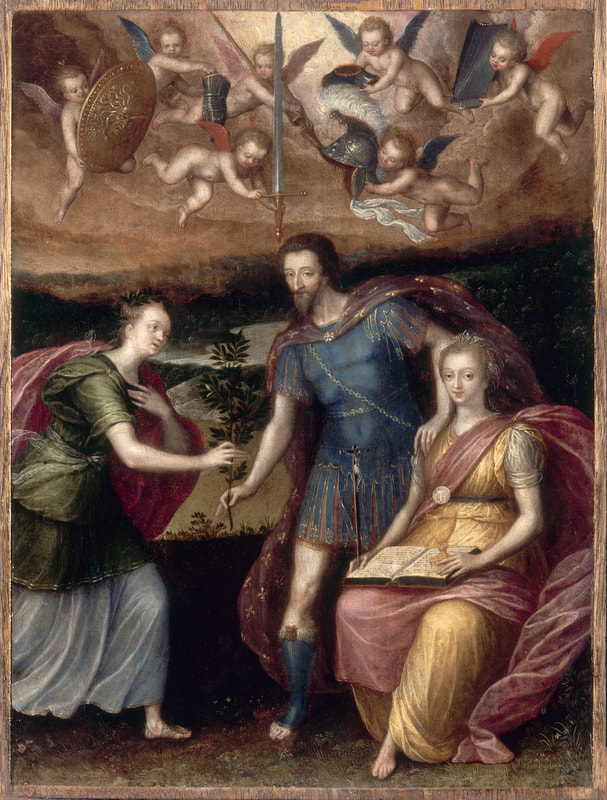
Anonymous, King Henry as the restorer of peace, ca. 1590. © RMN-Grand Palais (Château de Pau). Photo: René-Gabriel Ojeda
|
